Turbo Wood Lathes Troubleshooting: Quill Movement Difficulty

Created by Gabriel Izzo, Modified on Wed, 20 May at 6:51 PM by Gabriel Izzo

Turbo Wood Lathes · Troubleshooting
Quill Movement Difficulty
Applicable Models
Harvey Turbo T-40 Wood Lathe
Harvey Turbo T-60S Wood Lathe

When experiencing difficulty with the tailstock quill movement, it's essential to assess whether the issue stems from misalignment, damage, or a need for lubrication. Follow the steps below to inspect and resolve the issue.

Safety — Read Before Beginning
+
Unplug the lathe from the power source before performing any maintenance, disassembly, or adjustments to the tailstock. Confirm the machine is fully de-energized before touching any components.
+
Wear appropriate PPE — safety glasses to protect your eyes from debris, and nitrile or similar gloves to protect your hands during disassembly, cleaning, and lubrication.
+
Ensure the tailstock is fully reassembled and all fasteners are properly tightened before returning the lathe to service. Test the quill movement manually — extend and retract it fully — to confirm smooth operation before use.
Part 1
Removing the Tailstock Quill & Lead Screw
1
Unlock the Tailstock

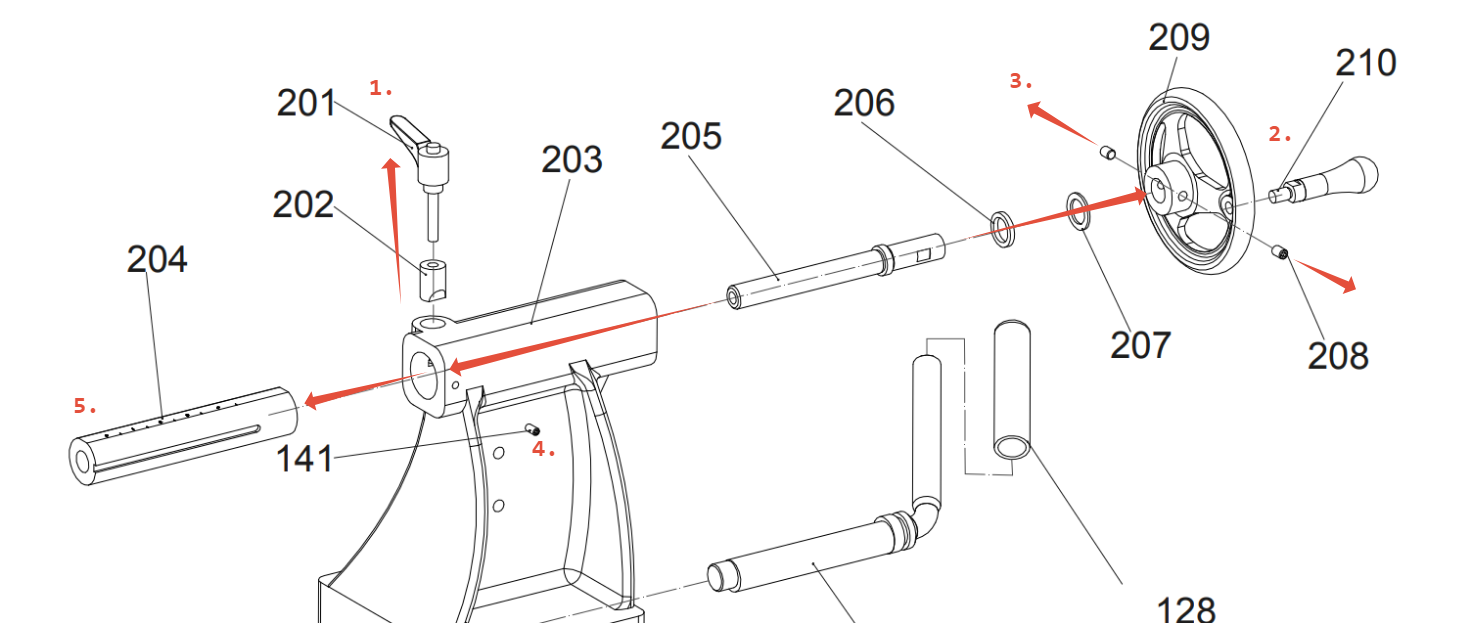
Loosen the lock handle (201) on the tailstock to free the quill.

2
Extend the Quill

Rotate the handle until the quill/sleeve (204) is fully extended outward, exposing the internal components for easier access.

3
Dismantle the Handle Assembly
Remove the set screws (208) that anchor the handle to the end of the lead screw (205).
Remove the handle (209), followed by the position ring (206) and washer (207).
4
Remove the Quill and Lead Screw
Extract the set screw (141) that holds the quill assembly in place.
Gently pull out the quill/sleeve (204) and lead screw (205) through the tailstock. Do not apply excessive force that could cause bending or damage.
Quill & Lead Screw Assembly — Reference Diagram
Quill and lead screw assembly reference diagram
Part 2
Inspection & Maintenance
1
Examine for Damage
Separate the lead screw from the quill by unthreading them. Inspect each part thoroughly for bends or noticeable distortions.
Check for wear, burrs, or foreign material that might obstruct smooth operation.
2
Clean and Lubricate
Clean the quill, lead screw, and interior of the tailstock using a suitable cleaner such as WD-40 to remove old grease, dirt, and any corrosive build-up.
Wipe down all parts until dry and free of cleaning residue.
Apply a high-quality general-purpose grease to the threads of the lead screw and the exterior of the quill. This is critical for smooth movement and preventing future sticking or binding.
Reassemble and Test
Reinstall the quill and lead screw by following the disassembly steps in reverse order.
Test the quill by extending and retracting it fully to confirm it moves smoothly without resistance.
If the quill still exhibits difficulty after these steps, further investigation into the tailstock alignment or internal mechanism wear may be required. Contact our support team for further assistance or to source a replacement part.
i

Regular maintenance and prompt attention to operational issues are key to the longevity of your lathe. For further assistance, please contact our support team.

Was this article helpful?

That’s Great!

Thank you for your feedback

Sorry! We couldn't be helpful

Thank you for your feedback

Let us know how can we improve this article!

Select at least one of the reasons
CAPTCHA verification is required.

Feedback sent

We appreciate your effort and will try to fix the article